T-45 vs. T-51B: Choosing Your First Power Armor Build
If you've decided power armor is your first build, the next decision is which variant. Our difficulty rankings guide covers every major variant, but two designs come up more than any others when builders are choosing a starting point: the T-45 and the T-51B. Both are iconic. Both are achievable for a motivated first-time builder. They're not the same build, though, and picking the one that matches what you actually want out of the project matters more than picking the "correct" one.
This guide puts them side by side.
The Short Version
The T-45 is the more forgiving build: boxier, more geometric panels, a more forgiving paint scheme, and the lowest barrier to entry of any full power armor variant. The T-51B is a step up in surface complexity (more curves, more compound geometry) but rewards that extra effort with the sleeker, more iconic silhouette most people picture when they think "post-war power armor." Neither is objectively better. They're different trade-offs between build difficulty and visual payoff.
Design and Silhouette
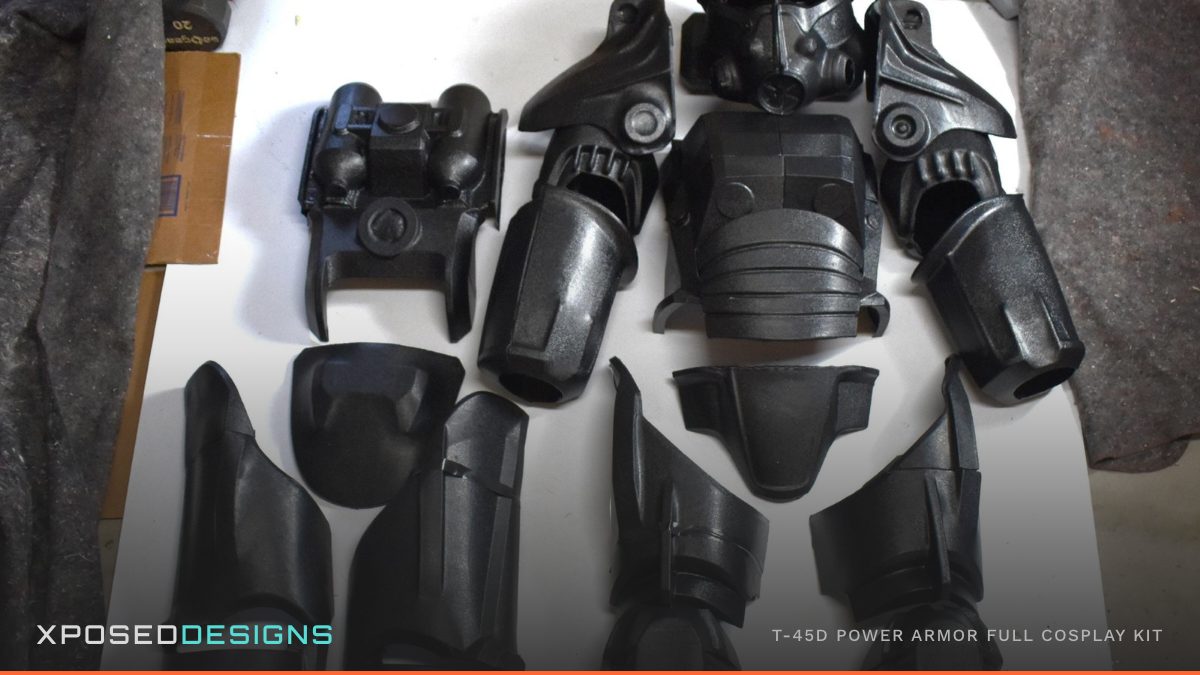
T-45 reads as rugged, industrial, and early-generation. The armor panels are broad and relatively flat, with a boxy chest, simple limb shapes, and a distinctive but geometrically manageable helmet. It's the design most associated with the earliest chapters of the post-apocalyptic timeline, and the suit that appeared prominently in the early episodes of the recent television adaptation, which has kept it culturally current even though it's the oldest design in the lineup.
T-51B reads as sleek and retro-futurist: rounded shoulder pauldrons, a distinctive ribbed chest plate, and an art deco sensibility that sets it apart from every other variant. It's the design most people default to picturing when they hear "power armor" in this genre, which gives it strong instant recognition at any convention or event.
If instant recognizability across a broad audience (including people who aren't deep fans) matters to you, the T-51B has a slight edge. If you want something that reads as gritty and battle-worn from the moment it's finished, the T-45's industrial simplicity does that naturally.
Build Difficulty
T-45: the easiest full power armor build in our lineup. The relatively boxy geometry means less compound curvature to fight, whether you're working from a kit or from raw materials. It's genuinely approachable for a first-time builder, and even a partial build (chest, shoulders, helmet) reads clearly as T-45 without requiring every piece to be finished.
T-51B: a meaningful step up in complexity, primarily because of the curved chest and rounded helmet brow. Getting those curves accurate from raw sheet material is where scratch builders lose the most time; a thermoformed kit removes that specific challenge by delivering the curved shells already formed, which is a big part of why we build this one specifically in thermoformed ABS.
Estimated build time for the T-45 runs roughly 50 or more hours for a beginner, 16 to 24 hours for an intermediate builder, and around 8 hours for an expert working efficiently. The T-51B takes longer from raw materials, though the ABS kit path cuts that time roughly in half compared to a scratch foam build, since the hardest geometry is already handled for you.
Paint and Finishing
T-45 paint schemes tend toward olive drab and weathered metal, both achievable with spray cans and basic dry-brush and wash weathering technique. You don't need an airbrush or advanced masking skills to get a convincing result.
T-51B paint schemes lean toward the iconic teal-and-chrome or military green colorways. The surface itself isn't loaded with fine recessed detail that demands precise masking, which keeps the paint job accessible even though the underlying shell is more complex to form. It's also one of the best-documented builds in the community, so reference photos and prior build breakdowns are easy to find if you want to match a specific look closely.
Either build follows the same process covered in our ABS painting guide: assemble first, paint the assembled suit second, and don't rush cure times between coats.
Weight, Comfort, and Wearability
Both suits are built from thermoformed ABS, which means both share the same core wearability advantages over foam or heavy 3D-printed alternatives: lightweight, breathable enough for a full convention day indoors or out, and weather resistant if your event includes any outdoor time.
The T-45's boxier panel structure distributes a bit more evenly across broad, flat surfaces, which some builders find slightly easier to fit comfortably against the body without extensive internal padding work. The T-51B's curved chest and pauldrons hug closer to the body's actual contours, which can look sharper in photos but rewards a more careful fit process, particularly around the shoulders where the rounded pauldrons need to clear your natural range of motion.
Neither suit requires the stilts or heavy internal harness systems that some of the bulkier, more advanced power armor variants call for. Both are approachable for a builder who wants full mobility (walking, sitting, turning through doorways) without engineering a load-bearing undergarment first.
Cost and Availability
Both variants are available as thermoformed ABS kits across DIY unassembled, assembled, and assembled-and-painted tiers. Cost scales with tier and scope the same way across both suits; see our cost breakdown guide for the full pricing framework by build type. Neither suit has a meaningful cost advantage over the other at the same tier; the price difference between variants, where it exists, tracks piece complexity more than anything else.
Which One Should You Build First?
Choose the T-45 if: this is your first ever armor build of any kind, you want the fastest path from kit to finished suit, or you're drawn to a rugged, battle-worn, early-generation aesthetic.
Choose the T-51B if: you have some prior fabrication or paint experience (even outside armor specifically), you want the design most people instantly recognize as power armor, or you're building toward a specific reference image with the retro-futurist silhouette.
A third option: many builders complete a T-45 first specifically to build confidence and process familiarity, then move to a T-51B (or another more complex variant) as a second project once they've been through a full build cycle once. There's real value in that sequencing. Your second suit always goes faster than your first, regardless of which variant you choose, because the fundamentals (assembly order, painting process, strapping strategy) carry over.
Whichever you choose, the T-51B power armor full suit kit is available now across all three tiers. Browse the full lineup, including both variants and everything in between, at xposeddesigns.com/collections/all.
Still not sure which build is right for you? Tell us your experience level and timeline in the comments and we'll help you decide. Follow @XposedDesignsLLC on Instagram for build comparisons and progress photos of both suits.